
Registrars send transcripts as PDFs. Verification happens through a database. By any practical measure, the paper credential stopped being the record years ago — and yet no institution has stopped ordering diploma holders. That is worth sitting with, because the reason is not nostalgia.
The ceremony is the product
A convocation is one of the few moments an institution stages in physical space, in front of the people whose opinion of it matters most: graduates, families, donors. The holder is the only object that crosses the stage. It gets photographed, it goes on a wall, it gets handed around a dinner table that evening. For thirty seconds it is the school.
That is a short brief and a demanding one. The holder has to open cleanly on a stage, sit flat for a photograph, survive a car trunk, and still look composed on a shelf ten years later.
What separates a good holder from a cheap one
Three things, in our experience on the shop floor in Laval:
- The edge. A turned-edge holder has its covering material wrapped and glued around the board, so no raw edge is exposed. It costs more and it is the single most visible difference between a holder that reads as considered and one that reads as an afterthought.
- The corners. Heat-sealed corners keep their shape; loose corners curl within a season, especially in a dry building in February.
- The fit. A certificate that shifts inside its pocket looks careless in every photograph taken of it. Pocket geometry should be built around the actual document, not around a nominal paper size.
Sizes, and why the list is longer than people expect
Letter (8½ × 11), legal (8½ × 14) and A4 (210 × 297 mm) cover most of North American and international academia. Beyond that, 10 × 13, 11 × 14 and 12 × 18 exist because art schools, military colleges and professional orders issue larger sheets — and because a certificate trimmed to fit a stock holder is a certificate nobody frames.
Right-and-left opening formats are worth knowing about too: they let an institution present a diploma and a letter, or a diploma and a bilingual certificate, side by side in one object.
Material is a decision about the next ten years
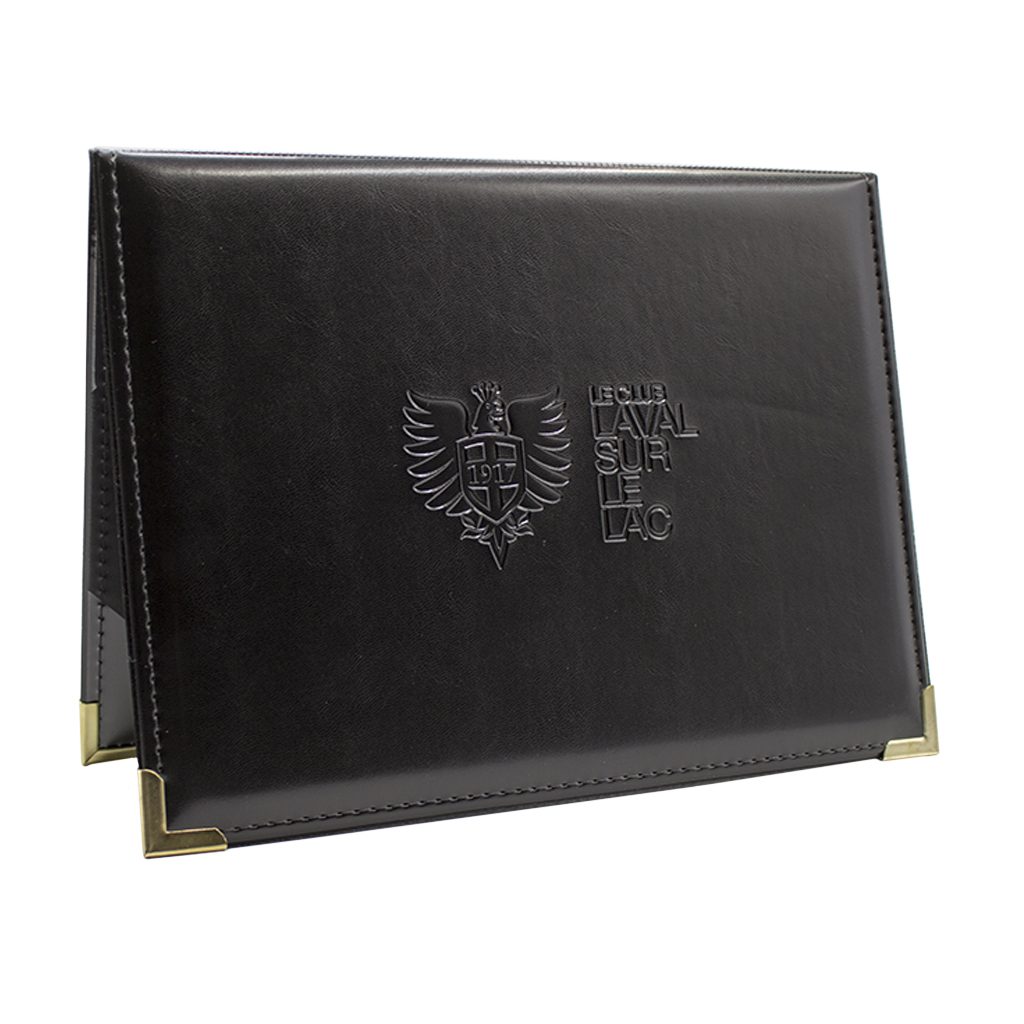
Vinyl is durable, wipes clean and takes hot stamping beautifully — it is the workhorse. Synthetic leather and leatherette read warmer and carry an embossed crest better than they carry foil. Padded construction adds perceived weight, which matters more than it should and is the cheapest luxury signal available.
Whatever the material, ask for a physical sample before committing a class year to it. Screen colour is an approximation; foil on a dark leatherette in daylight is the real test.
Imprint: restraint wins
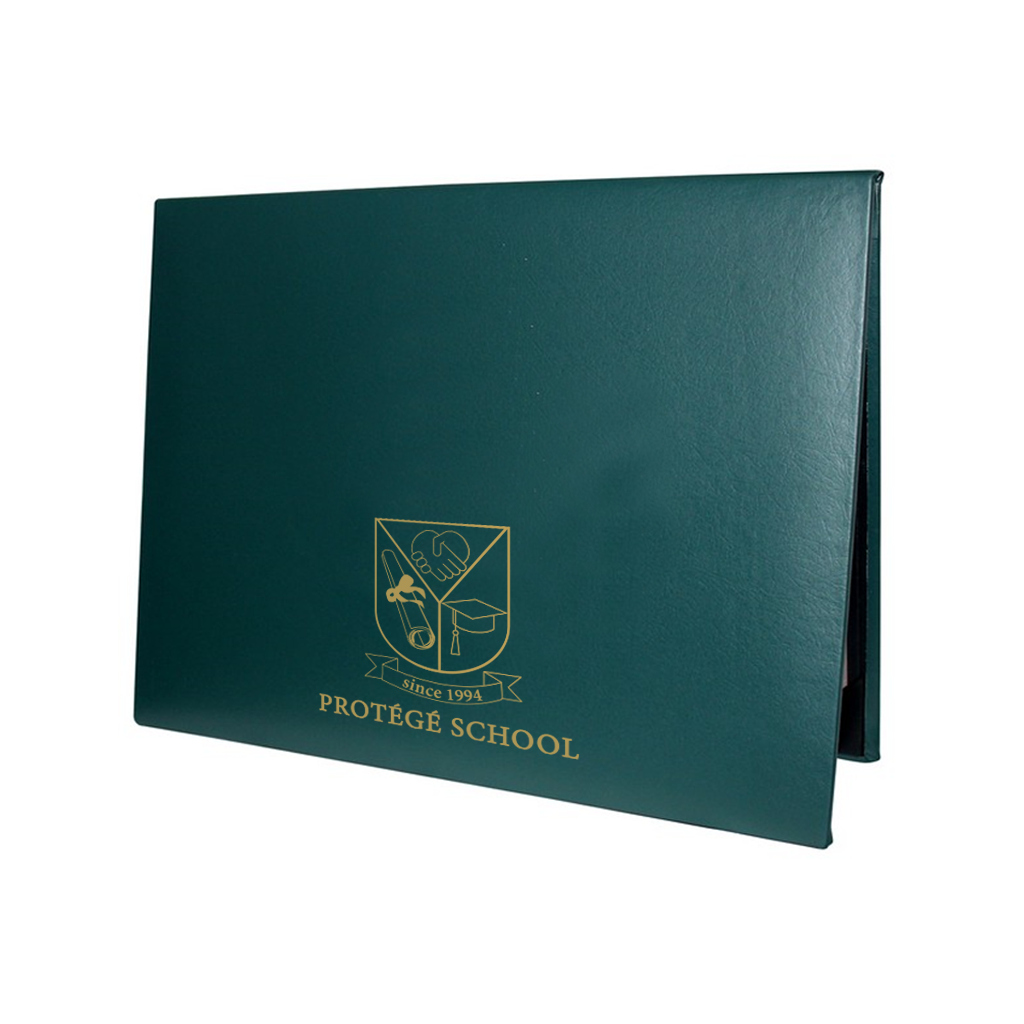
Hot stamping in gold or silver foil remains the standard for crests, and for good reason — it catches stage lighting. Blind embossing, with no foil at all, is the quiet option and photographs beautifully on textured stock. Silk-screening makes sense when the mark is complex or when a specific brand colour is non-negotiable.
One mark, centred, sized to the crest and no larger. Institutions that resist the urge to add a tagline end up with an object graduates keep.
Questions worth asking a supplier
- Is the edge turned, or heat-sealed and trimmed?
- What is the actual inside pocket dimension — not the nominal size?
- Can I see a stamped sample in the exact foil and material combination?
- What is the lead time after proof approval, and does it include the die?
- Can the same crest die be reused next year?
The digital credential won. The ceremony did not go anywhere, and the object that carries it is still the one thing a graduate takes home.