

Every few years someone announces the end of the binder, and every few years binder volume in professional services goes up. It is worth understanding why, because the answer tells you what to specify when you order one.
A binder is a controlled environment
A shared drive is infinite and unranked. A binder is finite and ordered. Someone decided what goes in it, in what sequence, and where it stops. That editorial act is the entire value: a training manual, a franchise operations guide, a board package or an in-room hotel directory is curated in a way a folder of PDFs never is.
It is also the only format in a meeting where you can see, at a glance, how far along everyone is.
Where binders still win outright
- Onboarding and training. New employees retain a sequence better when they can flip back. Tabs beat search when you do not yet know the vocabulary.
- Field and shop-floor use. A vinyl binder wipes clean, works with gloves on, and does not need a charge. In a garage, a plant, a clinic or a job trailer, that is decisive.
- Regulated documentation. Safety data, permits, inspection logs and procedures often have to be physically present and current at the site.
- High-stakes presentations. Leaving a well-made binder behind after a pitch keeps the proposal on a desk instead of in an inbox.
Specifying one properly
Capacity first. Ring size is not page count. A 1″ ring holds roughly 175 sheets of 20 lb bond; a 2″ ring roughly 375. Order a size up if the document is meant to grow — an overstuffed binder fails at the ring, not the cover.
Ring type. Round rings are the economical default. D-rings hold more per inch and keep pages flat and aligned, which matters when the binder is read rather than stored.
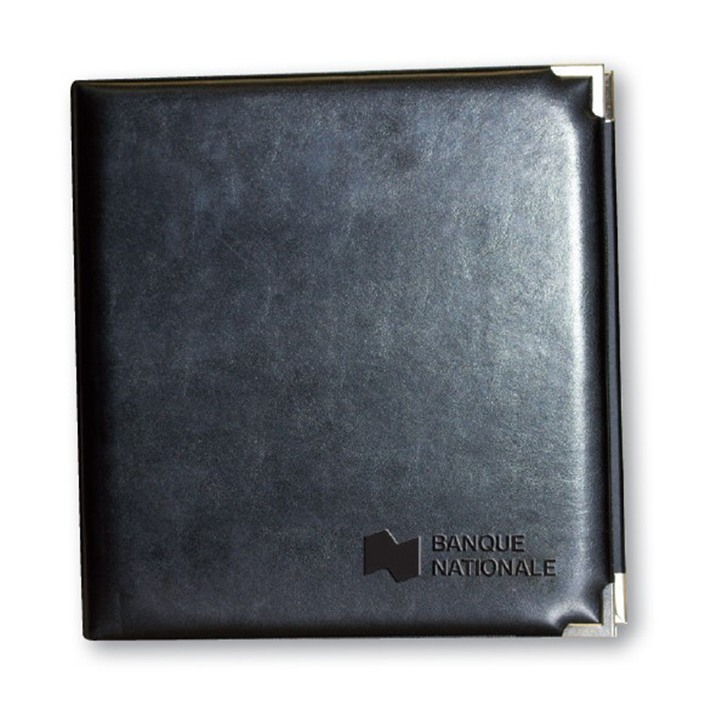
Covering. Vinyl for durability and cleanability. Synthetic leather or leatherette when the binder is client-facing. Turned-edge construction — material wrapped around the board rather than heat-sealed at the edge — is the finish people notice without knowing why.
Pockets and closures. Inside pockets, business card slots, pen loops and a velcro or elastic closure each solve a real problem; each also adds cost. Specify the ones the user will actually use on the day.
Imprint that ages well
Hot stamped foil on a dark cover is the classic and holds up for years. Blind embossing on leatherette is quieter and more expensive-looking than either. Silk-screening carries a multi-colour logo faithfully. Spine imprinting is the most under-ordered option in the category and the most useful — a binder lives on a shelf, edge-out, far longer than it lives on a desk.
The distributor’s angle
Binders are a repeat line, not a one-off. Training programs re-run, franchise networks add locations, hotels refresh rooms, boards meet quarterly. A binder specified well the first time becomes a standing order with a stable die and a known lead time — which is a better business than chasing the next novelty item.
Software replaced the filing cabinet. It did not replace the moment when everyone in the room turns to the same page.